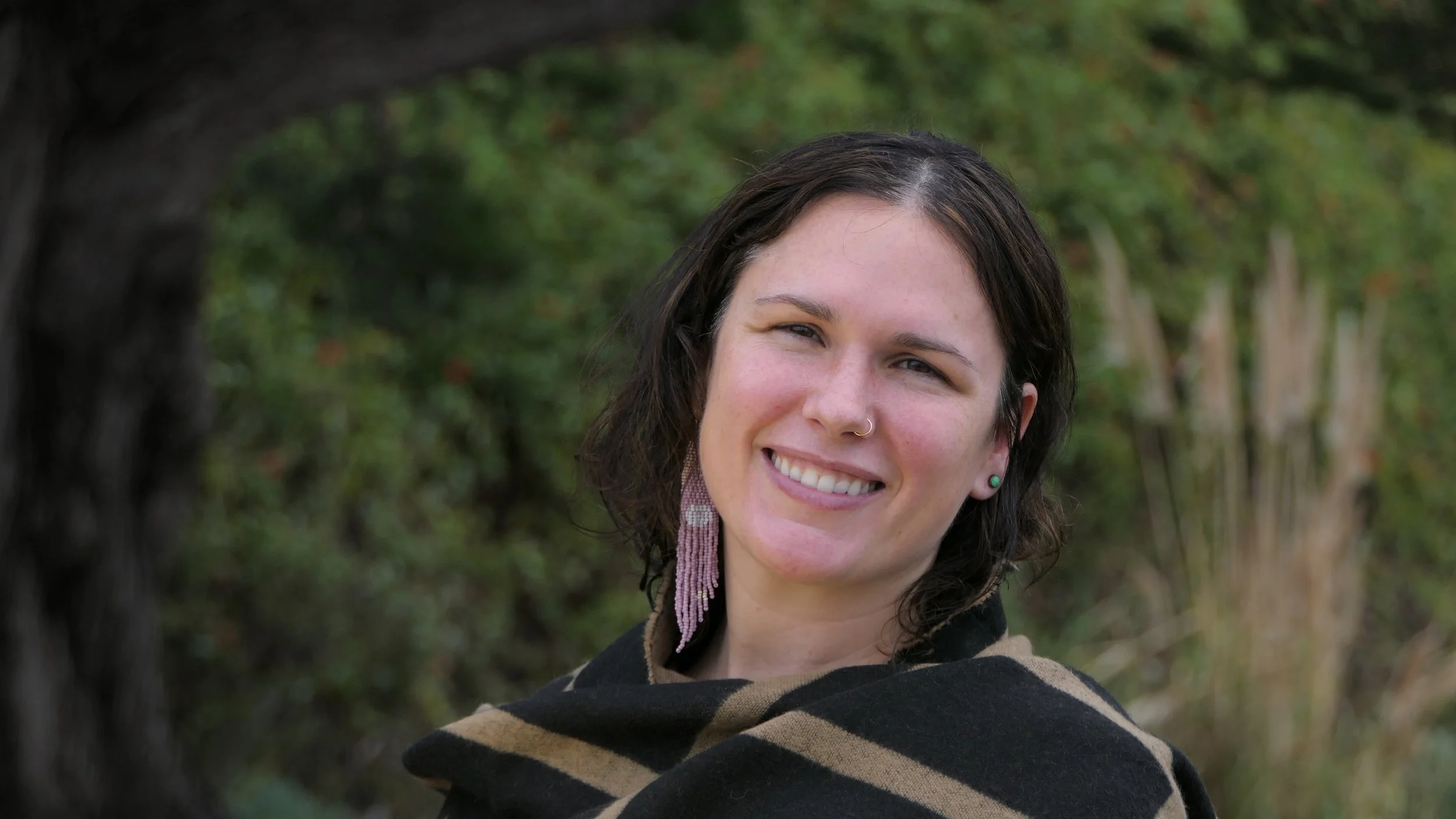
Whitney Bell is an Esalen® Massage practitioner and teacher, and a Gestalt facilitator. Her professional path began with a traditional massage education, completing a 650-hour training and establishing her own practice. At that stage, Esalen Massage was not central to her work. As she explains, she “pulled Esalen Massage out of a hat as a side project” alongside her existing modality.
Listen to the full interview:
Discovering Esalen Massage at the Esalen Institute
Whitney’s first encounter with Esalen Massage took place at the Esalen Institute in a class taught by Perry Holloman. Although she grew up in a family of massage therapists—her mother and aunt both practiced bodywork—what she encountered there felt entirely unfamiliar.
“I had never seen what I was witnessing before,” she says. What stood out was not technique, but “the beauty and presence that was being displayed while the practitioners were working.” Experiencing that presence, both as an observer and in her own body, clarified something immediately.
“Once I saw Esalen Massage, and once I felt my own experience in that class, I knew that I had to follow this path of touch.”
Returning to a Beginner’s Mind in Esalen Massage Training
Over the following year and a half, Whitney traveled repeatedly from Jackson Hole, Wyoming to Big Sur to continue studying Esalen Massage. During this time, she recognized that despite her prior education, there was a fundamental layer of the work she did not yet understand. “I realized there was this whole layer that I didn’t understand about the work,” she says.
Rather than adding techniques, she chose to begin again. “In order to actually develop the skills I wanted into mastery, I needed to go back and become a learner again,” returning deliberately “to a novice beginner’s mind.”
Presence as the Foundation of Esalen Massage Practice
Through this return, presence emerged as the foundation of Whitney’s work. She emphasizes that Esalen Massage is not about applying routines or performing techniques. “I’m not doing a routine on someone. I’m not doing a massage to somebody. I’m being with them.” Presence, for her, includes awareness of her own body, comfort, and inner state, while simultaneously attending to what unfolds with the person on the table.
This approach also transformed how she learned to perceive the body itself—“not compartmentalizing the body,” but taking it in “as a three-dimensional unit interconnected from the pinky toe all the way up to the head.”
Gestalt Awareness Practice and Embodied Attention
Whitney’s engagement with Gestalt practice developed directly through her Esalen Massage training. Regular check-ins during classes became her first exposure to Gestalt awareness. Her initial experience was intense—she recalls shaking, crying, and being unable to speak—but it sparked sustained curiosity. “What was that? Why did that happen?”
This inquiry led her into long-term Gestalt training and ongoing study. She describes Gestalt awareness practice as a disciplined training of attention. “It’s like going to the awareness gym,” she says, returning again and again to the questions, “How do I stay in the moment? How do I bring myself back?”
Movement, dance, and breathwork support this practice, helping her remain grounded and present in her own body while working with others.
No Coercion, No Judgment: Gestalt Principles in Touch
Over time, Whitney came to understand Esalen Massage as an embodied expression of Gestalt principles. “Esalen Massage is a version of me doing Gestalt work through a different format,” she explains. Her hands function as a way for people to perceive themselves more clearly, reflecting their own felt sense rather than directing change. Two principles guide her work consistently: “no coercion” and “no judgment.” Rather than trying to create a result, she says plainly, “I’m offering space for an unfolding.”
The Role of the Pause in Esalen Massage Sessions
A central element in Whitney’s teaching is the pause. She notes that the pause is often overlooked or treated as a formality, yet it plays a critical role in integration. “What is happening in that moment when I stop and drop into stillness?” she asks.
She has experienced how depth can increase significantly during these moments, describing times when she felt herself “drop twenty levels deeper” during a pause. For her, stillness allows shifts to register and settle. “That’s how change anchors in the nervous system.”
Lineage, Transmission, and Responsibility in Esalen Massage
Lineage, for Whitney, is not abstract. It is a lived responsibility. It means “honoring those who came before me” and carrying their life’s work forward through her own body, understanding, and teaching.
She sees Esalen Massage as something that must be protected and transmitted with care, ensuring that “this work lives on for more generations.”
Global Community and the Shared Field of Esalen Massage
When practitioners and teachers gather, Whitney experiences a shared field that transcends geography. She describes “this thread that connects us all,” a network of connections holding the work together worldwide. Coming together allows practitioners to reset, recharge, and return to their communities with renewed clarity and commitment.
Esalen Massage as a Life’s Work
When asked to complete the sentence “Esalen Massage is,” Whitney pauses before answering. “For me, Esalen Massage is my life’s purpose,” she says. She describes it as her ikigai and her life’s work, guided by a dedication “to leave this world better than I found it.”
Whitneys Workshops at the Esalen Massage Global Village
At the Esalen Massage Global Village, Whitney Bell will offer two workshops grounded in presence and awareness.
Deepening Presence in the Pause focuses on the role of stillness within Esalen® Massage sessions. The workshop explores how the pause supports integration, perception, and nervous system settling, and how practitioners can consciously inhabit this moment.
Gestalt Awareness Practice introduces foundational Gestalt principles through embodied awareness. Participants explore sensation, emotion, thought, and perception, and how these layers inform presence in both personal practice and work at the table.
